




Zero Trust Issues · #002
The preview pane is the attack surface
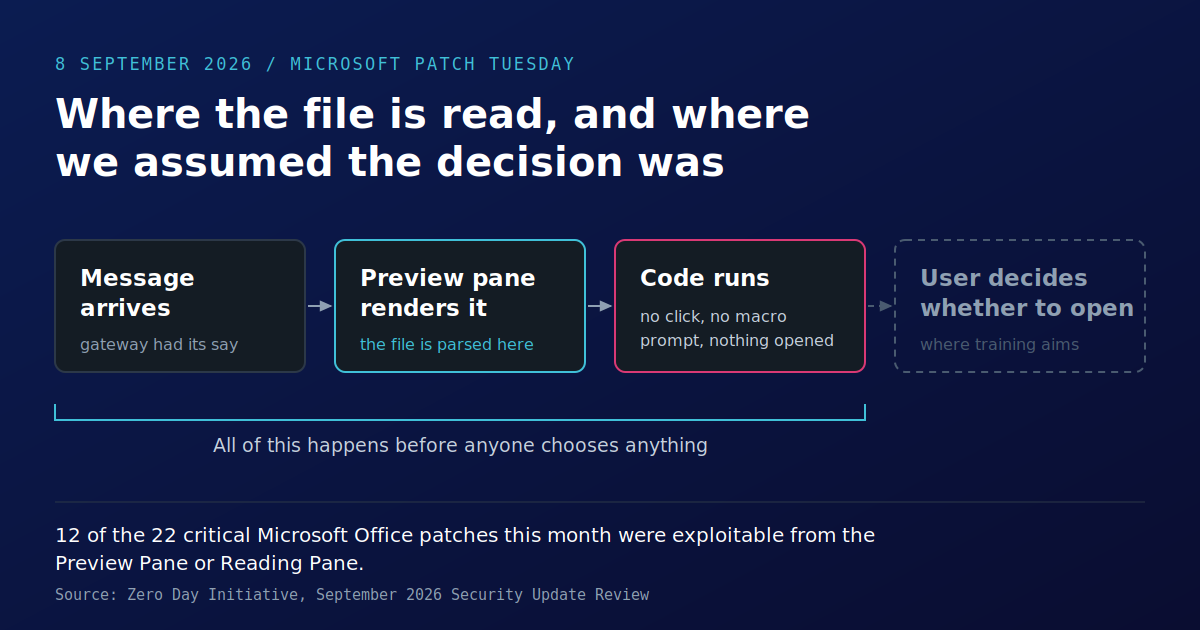
Twelve of the twenty-two critical Microsoft Office patches released on 8 September 2026 can be triggered from the preview pane, with nothing opened and no macro prompt shown. This piece sets out why rendering a file is the same thing as parsing it, why most user-facing guidance is aimed at a decision that never happens, and what a record patch release does to a fixed patch window.
Microsoft released its largest set of security fixes on record on 8 September 2026. The headline number depends on who is counting: Tenable put it at 964 CVEs, the Zero Day Initiative at 972, others higher still, because external and Chromium items get attributed differently. Roughly double the August total, about a hundred rated critical, two already being exploited in the wild.
The number that changes anything is smaller than all of those.
Twelve of the twenty-two critical Microsoft Office patches in that release can be triggered from the Preview Pane or Reading Pane, according to the Zero Day Initiative's review of the month. The three most severe of them carry a CVSS score of 9.8: CVE-2026-77493 in the Windows Graphics Component, CVE-2026-78510 in Word, and CVE-2026-78509 in Outlook's Reading Pane.
Nothing is opened. No macro prompt appears. The message arrives, the client draws a preview of the attachment, and the code runs.
Rendering is parsing
A preview pane is a convenience feature with a demanding job. To show you what is inside a file, it must first take the file apart: decompress the container, walk the record structures, resolve embedded fonts and images, run the layout, paint the result. Every one of those steps is code reading attacker-supplied bytes and making decisions about them.
That is the whole attack surface, and it is the part nobody thinks of as an action. Reading a file feels passive. It is not. A malformed length field, a crafted font table, a use-after-free in a graphics component: none of them require the document to be trusted, only for it to be drawn.
Which is why "supported file type" is a phrase worth being careful with. Every format a client can preview is a parser it is exposed through, and the more helpful the client is about showing you things without being asked, the more of that surface is reachable before any judgement gets made.
The decision that is not in the path
Almost every piece of user-facing guidance in circulation is built around an act of opening. Do not open attachments from senders you do not recognise. Check the address before you open it. Hover the link before you click it. Phishing simulations measure exactly this: who clicked, who opened, who reported.
All of that is aimed at a moment of human judgement. Twelve of this month's critical Office bugs sit upstream of it.
This is not an argument that awareness training is worthless. It catches credential phishing, business email compromise, the invoice that is not an invoice, and those are most of what actually arrives. It is an argument that awareness training cannot be the control for file-borne code execution, because the user is not in the loop at the point where the code runs. A programme reporting an excellent click rate has said nothing at all about this class of bug, because it measured a decision that was never on the path.
The honest reading of the preview pane is that it moves the trust boundary earlier than the mental model does. The boundary is not the user's decision. It is the moment a file the organisation accepted lands somewhere a client will render it.
The regulators already named this software
The instinct behind the rules is right, and it is worth saying so.
Australia's Signals Directorate strengthened the Essential Eight patch timeframe for applications that, in its own words, routinely interact with untrusted content from the internet: office productivity suites, web browsers and their extensions, email clients, PDF software and security products. That timeframe moved from one month to two weeks. The list is precisely the software this month's release hit hardest, and the stated reason is exactly the right one.
Singapore's expectations run the same direction from a different angle. The MAS Technology Risk Management Guidelines expect financial institutions to operate a patch management process that assesses severity and deploys fixes within a defined timeframe rather than when convenient, and CSA's Cybersecurity Codes of Practice carry the equivalent expectation for critical information infrastructure. Neither of them is unusual. Almost every framework in the region now states a patch window of some kind.
A fixed window against a variable release
Here is the part that does not get written down.
A patch window is a promise about your process. It says how quickly you will act once a fix exists. It says nothing about how much arrives at once, and that second number is set entirely by someone else.
Two weeks is a sensible commitment against an ordinary month. Against a month that ships more than 960 fixes, roughly a hundred of them critical, across an estate with change windows, test cycles, application owners on leave and a handful of systems that cannot be restarted during business hours, the window stops behaving like a deadline and starts behaving like a queue.
Queues have an order. Somebody picks it. In most organisations that ordering is done informally, by whoever runs the patch cycle, usually by CVSS score and sometimes by whichever system generated the loudest ticket. It is rarely recorded, rarely reviewed, and almost never made by the person whose signature is on the patch policy.
That is the gap this month exposes. The exposure window is not really a function of your diligence. It is a function of your diligence divided by the size of the release, and only one of those two numbers is yours.
A preview-pane-triggerable bug in a mail client deserves to be near the front of that queue, because it has no user interaction to slow it down and it sits in software that reads mail from strangers by design. Whether it got there this month is an answerable question, and answering it is more useful than the total.
What this is not
Three honest caveats, because the argument does not need help.
A record CVE count is partly a measure of how many people are looking. More researchers, better fuzzing, and vendor programmes that reward disclosure all push the number up without the underlying software becoming worse in the same month. The record is real, and it is not a clean risk signal.
Turning off the preview pane is a real mitigation, and it has a real cost. People who triage a hundred messages a day use it constantly, and a control that slows them down that much gets turned back on, formally or otherwise, within a quarter.
Patching remains the right answer to a patched vulnerability. Nothing here argues for doing less of it. The argument is about what a fixed window can promise when the release size is somebody else's decision.
The question worth asking
If your name is on the patch policy, the thing to ask this week is not whether you were inside the window. Most teams were, or will be.
Ask which items went to the front of the queue, who decided that, and whether the bugs that fire without anyone opening anything were among them. If nobody can answer, the ordering is the control, and it is currently undocumented.
For Australia's patch timeframes in their published context, see our Australia compliance page; for the MAS and CSA expectations, the Singapore compliance page.
Sources
- Zero Day Initiative: The September 2026 Security Update Review
- Tenable: Microsoft's September 2026 Patch Tuesday addresses 964 CVEs
- BleepingComputer: Microsoft September 2026 Patch Tuesday fixes 966 flaws, 2 zero-days
- SecurityWeek: Microsoft patches record 974 vulnerabilities, including two exploited zero-days
- ASD: Essential Eight Maturity Model changes (patch timeframes for software that interacts with untrusted content)
- ASD: Essential Eight Maturity Model
- MAS: Technology Risk Management Guidelines
- CSA Singapore: Cybersecurity Codes of Practice for CII
See it against your own files
We will bring the engine, you bring the documents that matter. Contracted, deployed and supported in-region by Safeware.
Talk to us